Headless Commerce vs Shopify: Which one scales better for 2026?
Headless Commerce vs Shopify: Which one scales better for 2026?
The digital retail landscape of 2026 is unforgiving. With rising acquisition costs and hyper-competitive global markets, e-commerce brands can no longer afford to be "just another store." The platform you choose today will either be the wind in your sails or the anchor dragging you down.
For many mid-market and enterprise brands, the debate comes down to one question: Do we stick with a traditional Shopify setup, or is it time to move to a Headless Commerce architecture? As experts in Next.js development, we’ve seen brands double their conversion rates simply by changing how they deliver their frontend.
1. Defining the Players: Monolith vs. Decoupled
To understand which scales better, we first need to define the fundamental difference in their DNA.
Traditional Shopify (The Monolith)
Standard Shopify is a "monolithic" platform. This means the frontend (what the user sees) and the backend (inventory, payments, database) are tightly coupled together. You use Shopify’s "Liquid" templating engine to build your store. It is fast to set up, but it comes with a "performance ceiling."
Headless Commerce (The Decoupled Powerhouse)
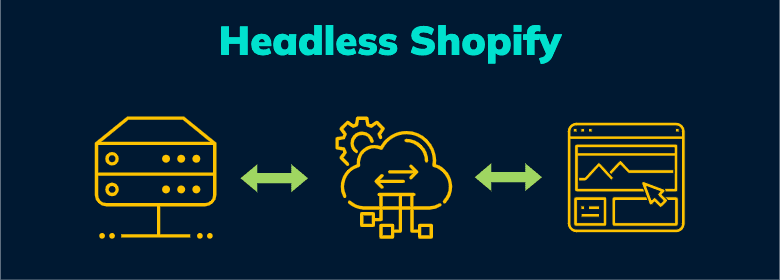
Our headless e-commerce solutions decouple the two layers. We use Shopify Plus or BigCommerce as a robust "commerce engine" (the backend), but we build a bespoke frontend using Next.js 15. The two communicate via high-speed APIs. This gives you the reliability of an industry-standard checkout with the lightning speed of a modern React application.
2. The Scaling Factor: Why Speed is the New Currency
In 2026, the "speed tax" on traditional e-commerce is higher than ever. As mobile networks become faster, user expectations have skyrocketed.
Milliseconds and the Bottom Line
A standard Shopify theme, burdened by multiple apps (for reviews, loyalty, pop-ups), often struggles to achieve a Lighthouse score above 50. In contrast, a Headless Next.js storefront easily hits 100/100.
When you scale your ad spend on platforms like Facebook or Google, a faster site directly lowers your Cost Per Acquisition (CPA). If you are migrating from a slow legacy store, our website migration to Next.js service ensures that every dollar you spend on marketing goes further by converting more visitors into customers.
3. SEO Dominance: Ranking in the AI-Era
Standard Shopify stores often suffer from rigid URL structures and "app-bloat" that creates messy code. In the era of AI-driven search (SGE), clean, structured data is non-negotiable.
The Technical SEO Advantage
By choosing Headless, we implement technical SEO optimization that is impossible on a standard monolith:
- Total Metadata Control: Every page, tag, and category can have custom, dynamically generated SEO logic.
- Instant Indexing: Pre-rendered pages mean Googlebot doesn't have to wait for JavaScript to execute.
- Structured Data: We wrap every product in perfect JSON-LD Schema, giving you rich snippets that increase your click-through rate in search results.
4. Customization and Brand Identity
Startups in 2026 need to stand out. If your store looks like every other "Dawn" theme on Shopify, you are a commodity.
For high-growth startups, the ability to create unique user journeys is a massive competitive advantage. Headless allows for:
- Bespoke Product Pages: Interactive 3D models, custom configurators, and immersive storytelling.
- Unified Brand Experience: If you are a solar startup selling both services and hardware, Headless allows you to merge your lead-gen blog and your store into one seamless, high-performance platform.
5. App Bloat vs. API Flexibility
One of the biggest issues with traditional Shopify is "App-interdependence." You want a new feature? You install an app. That app adds 150kb of unoptimized JavaScript to your site. Install ten apps, and your site is dead in the water.
In a Headless setup, we use APIs, not Apps. We integrate world-class tools (like Algolia for search or Sanity for content) directly into the code. This keeps your frontend lean and your site speed consistent, no matter how many features you add.
6. Global Expansion: Multi-Currency and Multi-Language
Scaling globally in 2026 means more than just a currency converter. It means serving content from local edge servers.
Traditional Shopify can be limited in how it handles regional SEO and localization. Next.js 15 handles Internationalization (i18n) natively. We can serve a tailored experience to a customer in Germany and a completely different one to a customer in the USA, all while maintaining sub-second load times via global CDNs.
7. Security: The "Fortress" Architecture
E-commerce sites are high-value targets. A monolithic platform has a larger "attack surface." If a popular Shopify app is compromised, your store could be at risk.
By moving to a Headless architecture, your backend is hidden behind an API layer. There is no direct "entry point" through the frontend. This level of security is a major selling point for enterprise clients and investors during technical due diligence.
8. Managing the Developer-Marketer Relationship
A common fear of Headless is that "Marketing won't be able to edit the site." We solve this by using a Headless CMS.
Your marketing team gets a visual editor that is even more powerful than Shopify's, while your developers focus on building new features in Next.js. This separation of concerns allows both teams to move faster without stepping on each other's toes.
The Psychological Impact of Zero-Latency Shopping
In the world of high-ticket e-commerce, the user experience is not just about aesthetics—it is about the "neurology of shopping." When a user interacts with a standard Shopify store, there is often a micro-delay between a click and an action. This is called "Interface Friction." While it might seem negligible, these micro-delays trigger a subtle sense of anxiety in the user’s brain, leading to lower trust and higher exit rates at the most critical moment: the checkout.
By building a storefront on Next.js 15, we eliminate this friction entirely. We implement Client-Side Navigation and Prefetching, which means that the moment a user's cursor hovers over a product, the data for that page is already being fetched in the background. The result? Transitions that feel instantaneous. In the consumer's mind, a store that responds instantly is perceived as more professional, more secure, and more premium. This "perceived quality" allows brands to maintain higher price points and increases the Average Order Value (AOV) by reducing the psychological barriers to adding items to the cart.
Solving the "App-Tax" and Performance Decay
Traditional Shopify store owners often find themselves in a cycle of "Performance Decay." To compete, they add apps for loyalty programs, upsells, and social proof. Each app adds its own script, often unoptimized and hosted on third-party servers. Over 12 months, a site that started "fast" becomes a bloated, sluggish mess. This is what we call the "App-Tax."
In our headless e-commerce solutions, we replace these heavy apps with lean, server-side integrations. If you need a loyalty program, we connect to the provider's API directly from the Next.js Server Layer. The user’s browser never has to download the heavy "bloatware" scripts. This ensures that your site stays just as fast on day 365 as it was on day 1. This architectural integrity is a key reason why high-growth startups are moving away from monolithic templates—they are tired of paying the performance price for basic functionality.
Data-Driven Personalization at the Edge
The future of e-commerce is personalization. But on a traditional monolith, showing different content to different users often requires even more heavy JavaScript, further slowing down the site. With Next.js 15, we utilize Middleware and Edge Functions. This allows us to detect a user's location, preferences, or past behavior and serve a personalized version of the store in milliseconds—directly from a server close to them.
Imagine a user from London seeing winter coats while a user from Sydney sees swimwear, with both pages loading in under 400ms. This level of dynamic content delivery was once reserved for giants like Amazon or Netflix. Now, through our Next.js development expertise, we make this "Enterprise-Grade" personalization accessible to mid-market brands. This doesn't just improve UX; it dramatically boosts your Return on Ad Spend (ROAS) by ensuring the right product is shown to the right person at the absolute right time.
Strategic Financial Advantage: The Long-Term ROI
Founders often ask about the "Total Cost of Ownership" (TCO) when comparing Headless to Shopify Monolith. While the initial investment in a Headless setup is higher, the long-term ROI is vastly superior.
- Lower Ad Costs: As your technical SEO improves and your bounce rate drops, your marketing efficiency scales. You stop wasting 40% of your budget on traffic that leaves because of slow speeds.
- Lower Maintenance Costs: You are no longer at the mercy of theme updates or broken app integrations. A custom-built Next.js frontend is stable, robust, and requires significantly less "babysitting" than a plugin-heavy WordPress or Shopify site.
- Higher Exit Valuation: If you ever plan to sell your e-commerce business, having a proprietary, high-performance tech stack is a massive asset. It proves that your brand owns its customer experience and isn't just a "reskin" of a generic template.
The "Hydration" Advantage and Core Web Vitals
Legacy React sites often suffered from "Hydration" issues—where the page looks ready but buttons don't work for several seconds. Next.js 15 solves this with Partial Prerendering (PPR). We can deliver the static, visual parts of your store (like product images and descriptions) instantly, while the dynamic elements (like the cart count or personalized pricing) stream in. This ensures you pass the Core Web Vitals with flying colors, keeping you in Google's good graces and providing a frustration-free experience for your customers.
9. Conclusion: Which one should you choose?
The decision depends on where you are in your journey:
- Choose Shopify Monolith if: You are a small brand, just starting out, with low traffic and a limited budget.
- Choose Headless Next.js if: You are doing over $1M in annual revenue, you are scaling your ad spend, you need total design freedom, or you are targeting a global market where performance is your primary competitive advantage.
At WebCreates, we don't just build stores; we build digital sales machines. We believe that for any brand looking to dominate in 2026, the transition to Headless is not a matter of "if," but "when."
Why Performance is the Best Marketing Strategy
You can spend thousands on the best copywriters and designers, but if your site takes 5 seconds to load, half your audience will never see their work. Speed is the foundation of the modern e-commerce "flywheel." Better speed leads to better SEO, which leads to more traffic, which leads to more sales, which leads to more budget for growth.
Ready to break the performance ceiling? Don't let a template-based store limit your brand's potential. Let’s engineer an e-commerce experience that is as fast as your customers expect.
Get a Free Headless Strategy Audit
About the Author
Cazim is the founder of WebCreates, a digital agency specializing in high-performance web engineering. He helps e-commerce brands and startups migrate to modern stacks to achieve global scalability and 100/100 Lighthouse scores.
Want a site this fast?
We specialize in building high-performance Next.js sites that rank. Let's discuss your project today.
Book a Free Consultation